

In an industry increasingly dominated by flashy renderings and bold marketing promises, it’s easy to forget the core truth about construction: a structure is only as good as its planning and execution. From the moment we sit down with a client to the final inspection of a newly completed country house, our process remains the same: architecture guided by experience, backed by engineering, and grounded in reality.
Oddly enough, the principles that drive us — stage-by-stage planning, cohesive execution, visual imagination, and structural integrity — are visible in the most unexpected places. Even in something whimsical like crafting themed event decorations, we see a mirrored philosophy: structure before decoration, function before fantasy.
Let’s explore why this mindset defines how we work — and why it guarantees quality.
1. The Blueprint Is Not a Picture — It’s a Technological Map
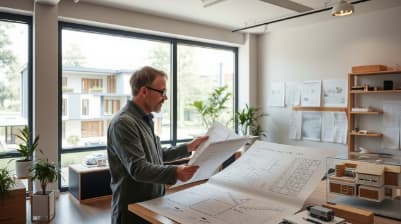
For many people, architectural drawings seem like just a prettier version of the final product. But in our world, a blueprint isn’t art — it’s engineering in disguise. It’s a multi-layered guide that defines structure, materials, geometry, utilities, and timelines. It tells every craftsman what to do, when to do it, and why.
Our team of architects and designers are trained not only to dream, but to design for implementation. The plans they produce go beyond aesthetics. They define systems — from foundation depth and thermal insulation strategy to precise ventilation routing.
Just as even the most imaginative decorative projects require structure before style, we understand that no great architecture is possible without an engineered roadmap.
2. Continuous Architectural Supervision Prevents Hidden Failures
A construction site is a dynamic, ever-evolving environment. Weather conditions, material deliveries, structural adjustments — everything is in flux. That’s why each of our projects is under the supervision of a lead project architect from day one until handover.
This continuity ensures that:
- Every design decision is implemented as intended
- Necessary adjustments are made in real time
- Contractors follow a coherent vision instead of interpreting plans on their own
Without that supervision, even the most beautifully drawn design can be misunderstood — and executed incorrectly.
We’ve seen too many structures built “almost right” collapse under the weight of poor communication or missing expertise. That’s why we insist on tight project control, just as even small-scale DIY projects depend on carefully following every stage to succeed.
3. Building in Phases Means Building with Confidence
Another core value we uphold is stage-based construction. Breaking a project into logical phases — each with a clear start, finish, and inspection — provides multiple benefits:
- Greater control over cost and time
- Higher quality standards at each checkpoint
- Easier coordination of subcontractors and teams
- Predictable milestones for client peace of mind
Clients often assume construction is a chaotic process. Our role is to show that it doesn’t have to be. Like assembling a complex system or creative craft, one step at a time is the only reliable way to reach the end result.
4. Design Must Work as Hard as It Looks
Good architecture is not a competition of visuals — it’s a combination of structural logic, utility planning, energy efficiency and human experience.
Every window placement considers daylight, insulation, and airflow. Every room layout accounts for movement, privacy, and function. Every exterior design element is connected to how rain flows, how wind behaves, and how shadows fall.
Even something like insulation or waterproofing is approached not as an “extra,” but as a fundamental part of the home’s performance. Form follows function — but both can coexist with grace.
5. Integration Is the New Luxury
Luxury in modern architecture is no longer defined by marble countertops or oversized windows. It’s defined by how well everything works together.
True luxury is:
- A heating system that adapts to your lifestyle
- A ventilation design that keeps air fresh without wasting energy
- Seamless lighting built into the geometry of the space
- Invisible systems that make living effortless
We collaborate across disciplines — HVAC engineers, interior designers, landscape architects — to ensure that nothing feels “added later.” Instead, every system, every light switch, every water outlet is built into the structure’s DNA.
6. Details Are Not Decoration — They Are Identity
Too many builders treat architectural detail as an afterthought — something to “add in” once the walls are up. But at Rotec, we believe that details are what make a house feel like a home.
Our approach to detail includes:
- Selecting materials that age gracefully
- Customizing features that reflect the owner’s lifestyle
- Ensuring consistency between form and finish
- Avoiding fads in favor of timeless proportions
Whether it’s a fireplace designed around a family gathering space or the subtle rhythm of shadow lines across a façade, details speak the language of permanence.
Even in creative pursuits like party design or visual storytelling, every final touch carries meaning. It’s not just what you build — it’s how it feels to live with it.
7. Architecture Is Not a Product — It’s a Partnership
Above all, we view architecture not as a commodity, but as a process of collaboration. We don’t simply deliver houses. We co-create environments. Our clients are never passive observers — they are active participants in shaping space, comfort, and future value.

Through every consultation, every revised drawing, every on-site meeting, our goal remains the same: to translate lifestyle into structure, and vision into experience.
Because what we build is not just a building. It’s the setting for lives, memories, and meaning.
Discipline Creates Freedom
It may sound paradoxical, but the more disciplined your building process is, the more freedom you have to create something extraordinary.
Architecture isn’t magic. It’s engineering, supervision, creativity, and consistency — brought together with care. And just like even the most imaginative themed project needs a plan, great living spaces only emerge from great systems.
At Rotec Radial Engines, we don’t believe in shortcuts. We believe in structure, sequence, and story — because that’s what turns design into a place you’ll love to live in.